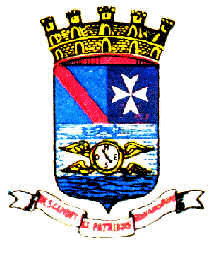
Amalfi Links:
Amalfi
History of Amalfi
|
Amalfi Links: Amalfi History of Amalfi |
is the place, where the merchants, who established the Benedictine Monastery St. Maria Latina in Jerusalem in AD 1048, came from. Their guesthouse was called the "Hospital of Jerusalem" and this became the historical cradle of the Order of Malta (which is actually called the Order of St. John of Jerusalem, of Rhodes and of Malta). The guest master of this Benedictine Monastery was Blessed Gérard, who founded a brotherhood to help him nurse the sick. This brotherhood very soon developed into an independent religious order, being the Order of St. John of Jerusalem. There are two conflicting traditions as far as Blessed Gérard's home is concerned. The one assumes that he comes from the island of Martigues next to Marseilles in Southern France and gives him the surname "Tenque" or "Tonque". The other theory calls Scala next to Amalfi his home and gives him the surname "del Sasso". The contemporary inhabitants of the little village Scala know little about the most famous of their sons.
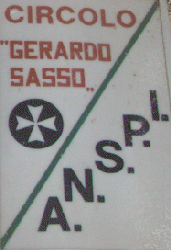
However, they have named a local church youth group after him: Circolo "Gerardo Sasso".
It took us a long time, after following three conflicting directions, to get to

the house called "Villa Saxo", which is believed to have been the seat of the "del Sasso" family.
There is very little left of what could have withstood the destructive powers of history for more than 900 years.
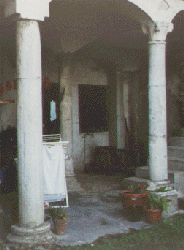
In fact, the family living in the "Villa Saxo" pointed out to us, that the columns in the basement of the building would be the only remainder of the former splendour.
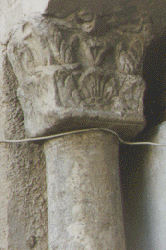
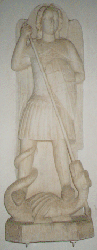
St. Peter's church in the village has a stone sculpture donated by Paolo de Saxo in 1358, probably depicting Blessed Gérard in the manner of St. Michael.
Another clue is the fact, that in the former Amalfi Cathedral (Basilica del Crocifisso), which is now used as a museum (Museo del Duomo), a fresco was found, which is also believed to show
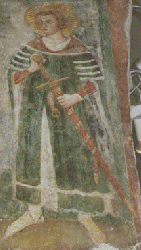
Blessed Gérard as a young knight.
We know for sure, that in Blessed Gérard's times, the Order was purely and solely a hospital order without any military tasks. The fresco depicts Blessed Gérard wearing a sword. Maybe Blessed Gérard was posthumously granted such an attribute, as his Order had developed into a military order later. [Interesting link: Le origini amalfitane del Sovrano Ordine di Malta]
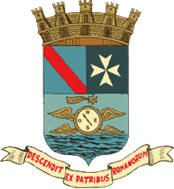
Where does that come from?
[1]
ÅPicture[2]
Earliest evidence:
The
eight-pointed design can be traced back to the 6th century AD in Byzantine
decorations and religious art . It was probably based on older Syrian or
Armenian cross forms as well as geometric patterns from the eastern
Mediterranean.
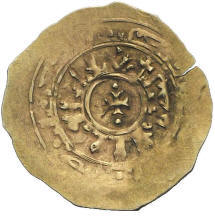
Historians assume that the symbol reached southern Italy either through Amalfi's
direct trade with Byzantium or via the
Normans . Amalfi was long under the cultural and political influence of the
Byzantine Empire, which facilitated the exchange of such symbols.
From emblem to
insignia:
Coin finds prove that
Amalfi already used the eight-pointed cross as a state symbol around 1080.
Since the founders of the Hospitaller Hospital in Jerusalem were merchants
from Amalfi, they adopted the familiar Byzantine-Amalfitan cross as the emblem
of their order.
Picture[3]
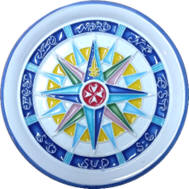 The symbolism seems somewhat
far-fetched to me: the eight-pointed shape of the Amalfi Cross is said to
visually resemble a compass rose . In Amalfi's maritime tradition, the
eight points of the cross were often associated with the eight cardinal
directions, which were crucial for compass navigation in the Mediterranean.
The symbolism seems somewhat
far-fetched to me: the eight-pointed shape of the Amalfi Cross is said to
visually resemble a compass rose . In Amalfi's maritime tradition, the
eight points of the cross were often associated with the eight cardinal
directions, which were crucial for compass navigation in the Mediterranean.
ÅPicture[4]
[2]Image source:
https://www.comuni-italiani.it/065/006/stemma.jpg
[3]Image: 1-Tari gold coin from
Amalfi. It was minted under King Ruggero II of Sicily, between 1130 and
1154. A Tarì was a widely circulated gold coin in medieval
southern Italy, originally derived from the Arabic quarter-dinar (
Ruba'i ). The coin has a Diameter of 21 mm and weighs 0.91
g .
Image source :
https://bertolamifineart.bidinside.com/en/lot/23491/italy-amalfi-ruggero-ii-king-1130-1154-/
[4] Image source : Author 's own
photo , taken in Amalfi as Souvenir bought .
This page is part of the Brotherhood of Blessed Gérard Newsletter No. 14 (Easter 1998)
This page was last updated on Tuesday, 10 March 2026 21:25:28
Back to the homepage of the Brotherhood of Blessed Gérard



