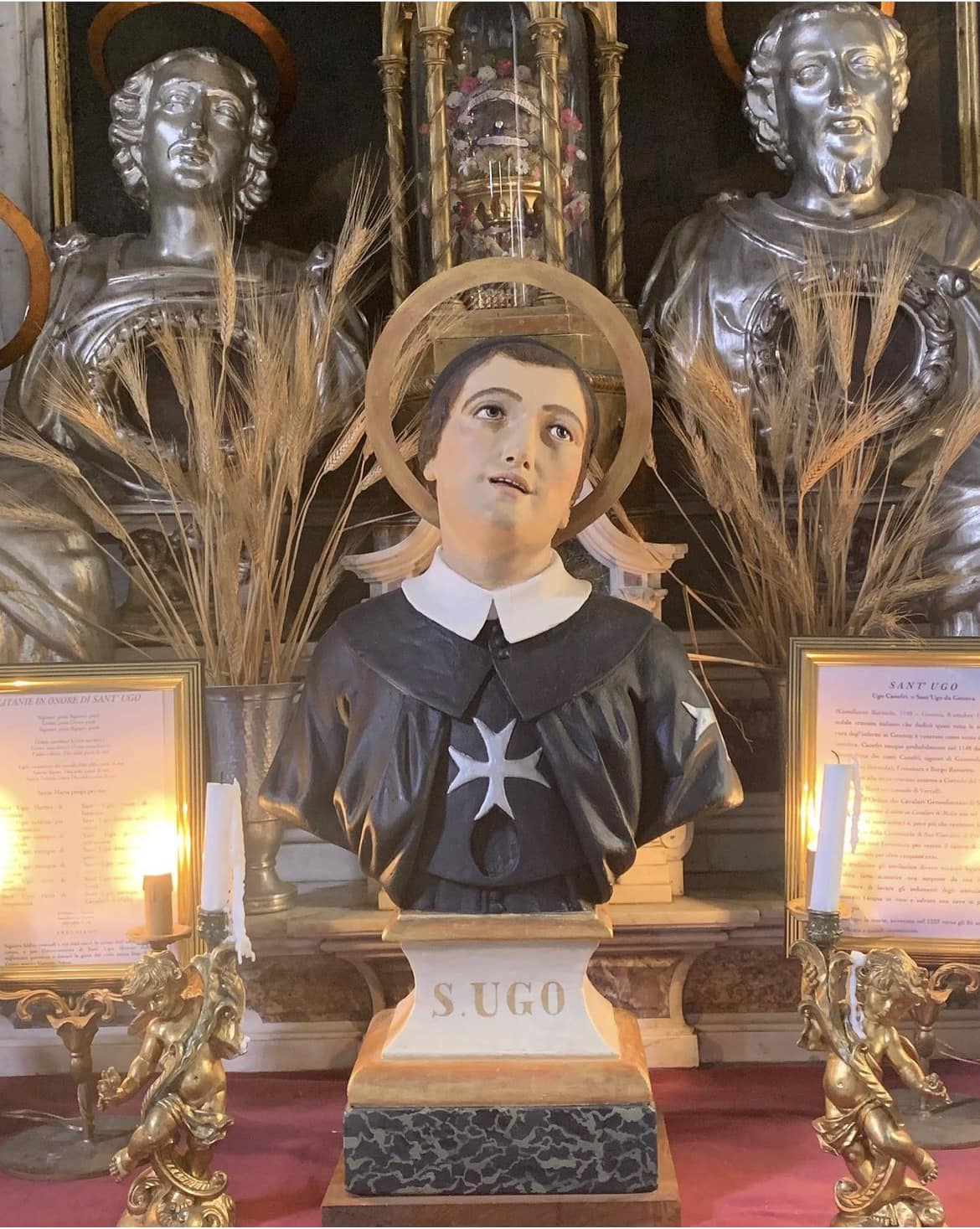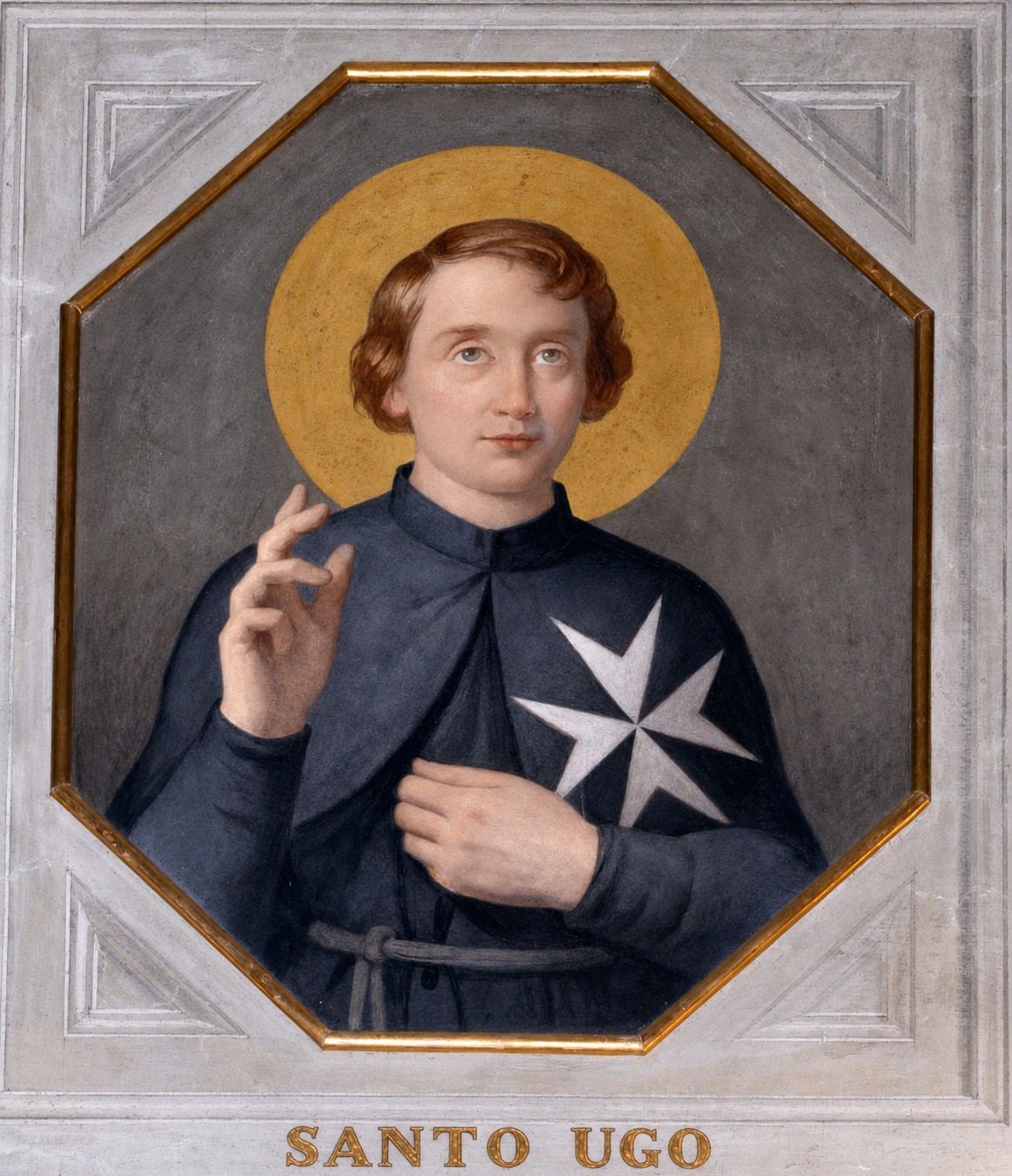
also called: Sant Ugo Canefri or Sant Ugo Canefro
Religious of the Order of Malta
Memorial: 8 October
Born about 1186 at Alessandria (Italy), he became a knight of the Order
of St. John of Jerusalem.
After lengthy campaigning in the Holy Land, he was elected
Master of the Commandery of St. John di Prè in Genoa (Italy) and worked in the infirmary
nearby.
He was renowned for miraculous powers over the natural elements.
He is believed to
have died in 1233*.
Prayer:
O God, who gave to St. Hugh power to heal the sick by the sign of the
cross, give us the spirit of your own love, to serve you in our sick brothers
and sisters.
We ask this through our Lord Jesus Christ your Son, who lives and reigns with you and the
Holy Spirit, one God, for ever and ever. Amen.
(From: The Missal with readings of the Order of St. John of Jerusalem of Rhodes, & of Malta, London 1997)
Saint Hugh is one of the most
highly venerated saints of the Order, although neither his origins nor the date of his
birth are known.
He was the Commander at Genoa and administered his Hospital in the best
of fashions.
That did not keep him from being an edifying, religious "exercising
religion toward God and his neighbours".
It is well known how much sacrifice and
devotion that phrase can contain.
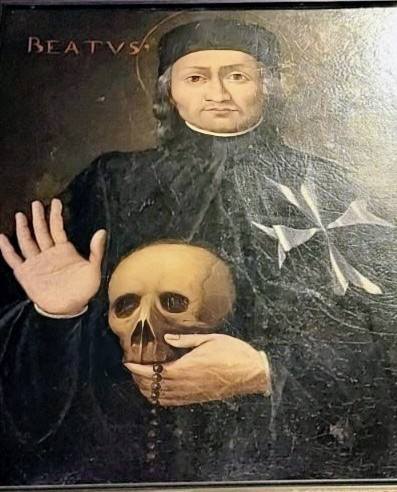
According to the portrait that Grandmaster
Cardinal Fra Hugh de
Loubenx Verdala gave the Order, an authentic portrait made while the saint was still
alive, we know that the latter was thin, with an ascetic face, and small in stature.
But
he was quite comely and amiable toward all.
His mortification was not onerous for others.
He slept on a board, in a corner of the basement of the Hospital; he served the poor with
love and tact, giving them food, money, spiritual comfort and brotherly love.
He
washed their feet.
He took care of them, and when they died, he buried them.
The
eight-pointed cross was not only on his cloak; he wore it in his heart.
So great was his
zeal that he girded himself with an iron belt placed next to his body.
He fasted the whole
year round, eating nothing cooked in Lent.
Each day he recited the office and heard Mass with such fervour that he often fell into ecstasy and was raised from the floor in the sight of all. His prayer was evidently continuous, and God rewarded him for it by a gift of working miracles.
These miracles were outstanding and attested by the Archbishop of Genoa, Otto Fusco, as well as by four venerable canons who frequented the house of the saint and witnessed his marvellous deeds.
-
On one of those sultry Italian days, when the sun crushes nature with burning heat, some women were in the common room of the infirmary washing the linen of the sick.
The water supply failed, for the fountain of the monastery had dried up.
They were dismayed, therefore, at having to fetch the water necessary for their task from a great distance.
They complained among themselves discreetly - that is, with great outcries - so that the saint heard them and came to them to inquire about the cause of their complaints.
Seeing him, they begged him to give them water, and, as he declined, they cried: "What? You wouldn't be able to get any from God?" "We must pray ".
"Oh! that's all we do. Hear us".
"I am not the Lord; He said that faith makes miracles. Have you faith?" They insisted; he resisted.
They wept, saying that they would die of exhaustion because of the work and the heat.
He hardly believed that, but through charity, after having invoked the Master of Nature, the saint made the sign of the cross and the waters gushed from the rock of the fountain, to the astonished cries of the servants. -
On another occasion, the worthy Knight was saying his prayers one evening at the top of the tower of the Hospital which dominated the port of Genoa.
A violent storm was raging and the venerable man noticed in the distance, through the curtain of rain and the tossing waves and clouds, a ship which was having difficulties in reaching the harbour.
It was in imminent danger of perishing.
Stirred to the bottom of his heart by the peril of the unfortunate sailors, Hugh fell to his knees amid the thunder and lightning and began to pray with tears streaming down his cheeks.
Then, confidently, he arose and facing the ship which was about to sink he made a great sign of the cross.
"Immediately a great calm occurred".
The winds died down, the sea became slack, and the moon shone in the clear sky.
When the galleon, thus saved, entered the port, it found the sailors who had gathered to come to its aid and who had not yet recovered from their surprise at the sudden subsiding of the storm.
Some of them had seen the saving gesture of the saint.
They all went in procession to the church of the Hospital to sing their thanksgiving to God and to his servant. -
In spite of his austerity, the Chevalier Hugh followed the laws of civility.
He would sometimes invite friends to lunch.
One day, Nicolas Pigliacaro, his guest, noticing with surprise that there as was nothing to drink on the table, got up to fetch water from the spring.
Now, it happened that after grace and the sign of the cross made by the venerable host over the food, the water had changed into excellent wine.
On four different occasions this miracle was repeated.
Nicolas assures us of it. -
And did not Brother Hugh of Sabezana, accompanied by the wife of a doctor of the Hospital, discover the Commander praying in the garden, his head surrounded by an aureole of fluttering and warbling birds, in the light of the Lord!
The woman took it upon herself to tell everyone about the event. -
Finally, there was in Genoa an unfortunate man possessed by the devil. The saint charitably went to visit him. On his approach, the possessed man went into convulsions and began to shout: "Hugh! do not torment me any more! I am ready to depart". And so it was. The mere sight of the venerable man had overcome Satan.
Brother Hugh died venerated by all (October 8, 1230), and was buried in
the church of St. John of Jerusalem in Genoa.
But, ardent in the service of his brothers
during his earthly life, he continued to help them in his eternity.
-
The same Pigliacaro tells us that a woman who had fallen under the power of the devil was carried to the tomb of the venerable man, and that evening, she vomited a very black and very foul-smelling toad; after that event, she was calm and free of her ills forever.
-
Later, there was a man whose leg tendons had contracted so much that he could not move.
He had himself borne to the holy tomb, where he stayed for five days and five nights.
His persevering prayer was finally heard.
Cured, he devoted himself to the service of the Hospital for the remainder of his life as he had vowed to do. -
And it happened that, nailed to her bed by gout, Dame Orto had not left her room for six years.
Shortly after the death of St. Hugh, because of his miracle-working fame, she wished to try his power.
Supported and led by her friend, Donna Maria, and Canon William della Barma of the cathedral of Genoa, together with one of the latter's confrères, she came to lay her supplication before the Blessed Knight, who courteously granted her wish.
Cured, she took the habit of the Order and served the poor of the Hospital during the rest of her life, as was done by the three witnesses of the miracle.
We are not astonished, therefore, that after such wonders, of which
Archbishop Fusco was himself the guarantor, the feast of the saint has been celebrated on
the day of his entrance into heaven, and that in all the churches of Genoa.
Formerly a
great procession was held to carry the head of the venerable man through the city, the
recipient of his favours, which returned to him in devotion all the good he had done for
it.
The office which honoured him was that of the Confessors not Pontiffs.
We shall
piously recite the beautiful liturgical prayer composed especially for St. Hugh:
"Oh, Lord, Who hast granted to Thy servant Hugh to cause in Thy
name, by the sign of the cross, to gush from a very hard stone a spring of living water,
to drive away demons and cure the sick, grant us, we pray Thee, that, rendering our homage
to him, we may feel its beneficent effects.
Through Jesus Christ Our Lord.
Amen".
May his faith - capable of moving mountains - his charity, vigilant and
tireless, as well as his other daily virtues, especially his gentleness and courtesy,
be for us an invigorating example!
And imitating him here below, may we share in his
eternal glory a glory - of prayer in a cloud of singing birds!
(From: Ducaud-Bourget, Msgr. François: The Spiritual Heritage of The Sovereign Military Order of Malta, Vatican 1958)
* Some sources date his death on 8th October 1230 or 1233
Sant' Ugo Canefri da Genova Religioso dell'Ordine di Malta
Saint John of Prè, Genoa, Liguria, Italy, Europe